
Last updated August 25, 2026
Free on-site gate assessment - hinges, posts, and your LiftMaster or Nice gate operator checked before anything is quoted
The assessment is free and the quote is the invoice.

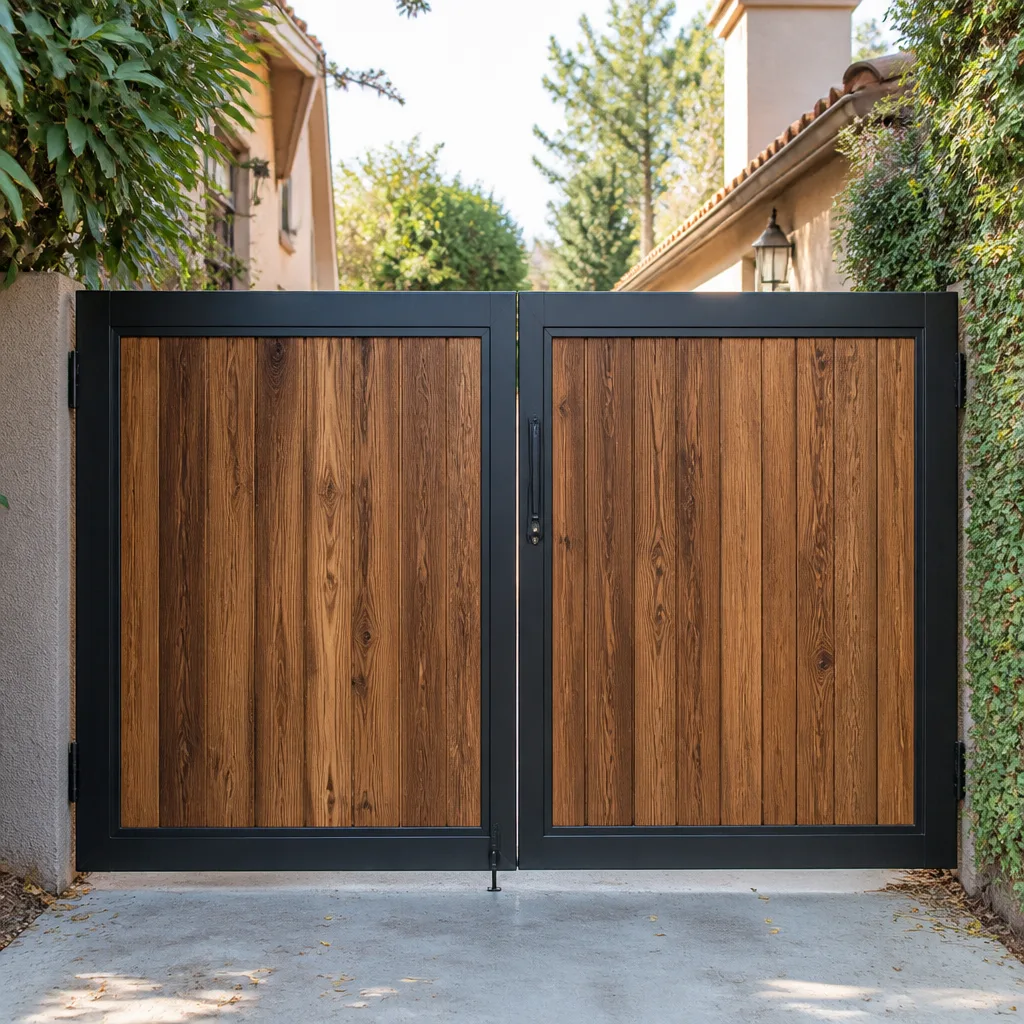
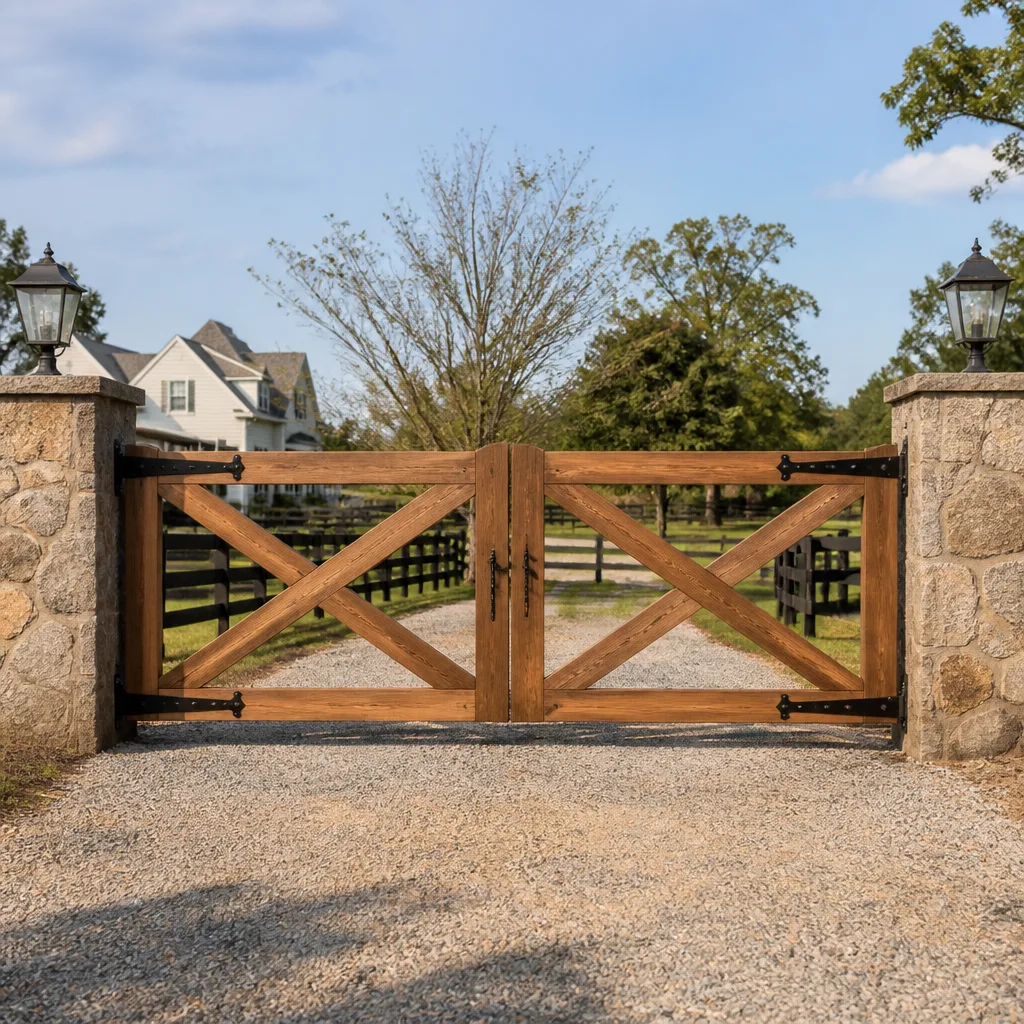
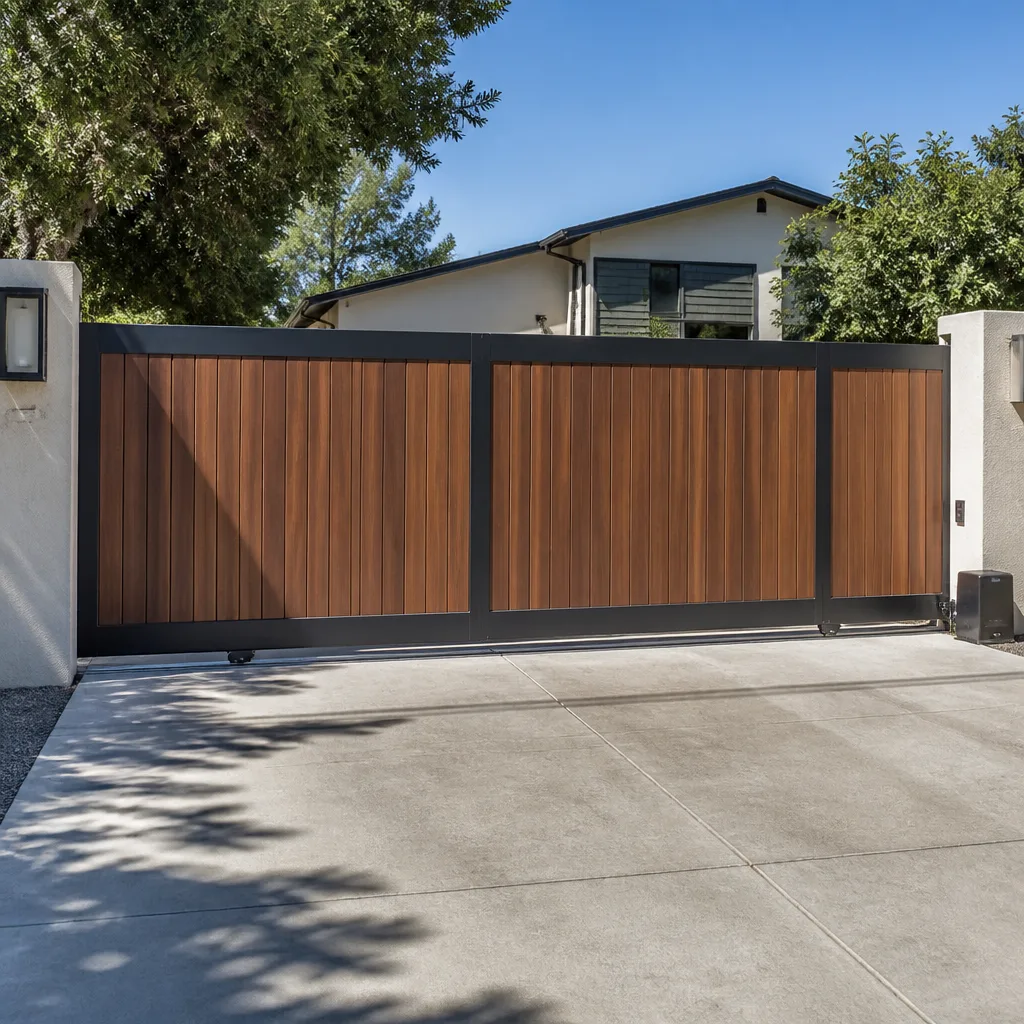
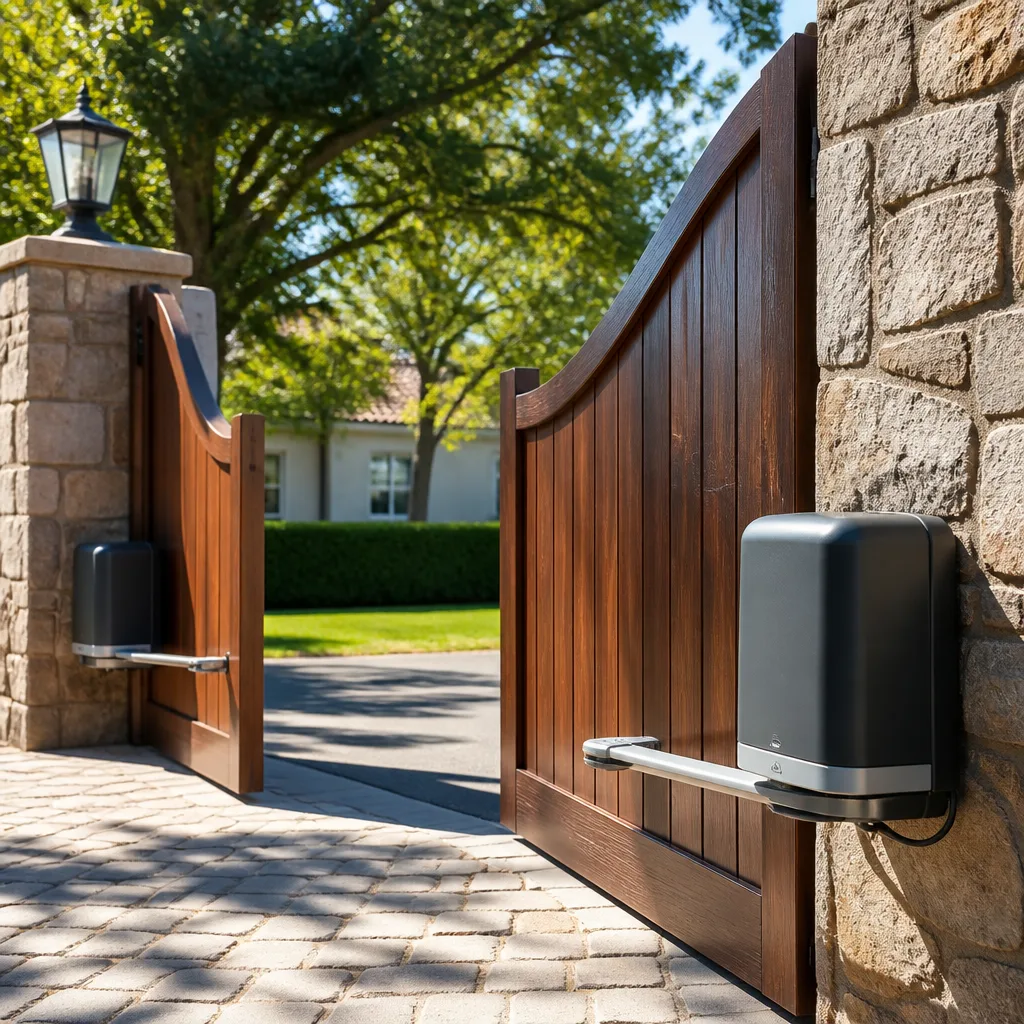
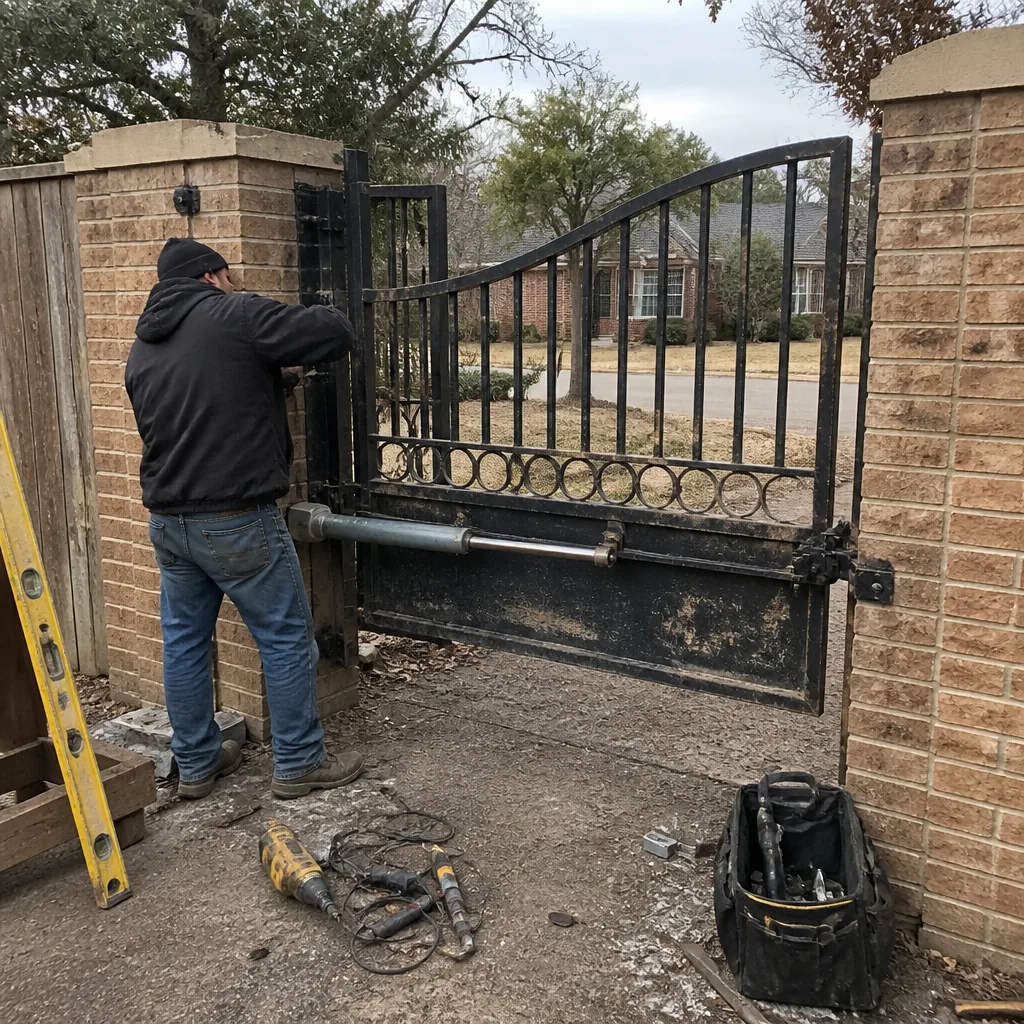 Before
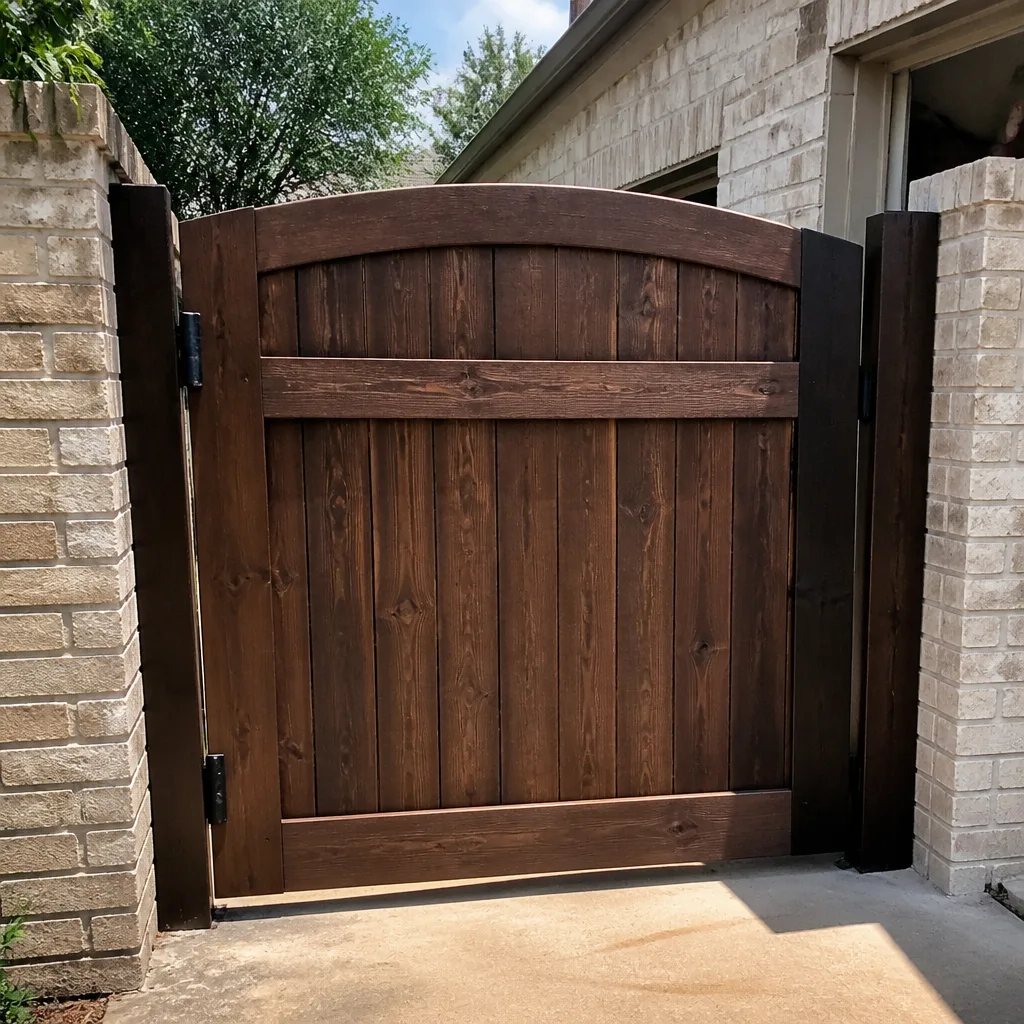 After
After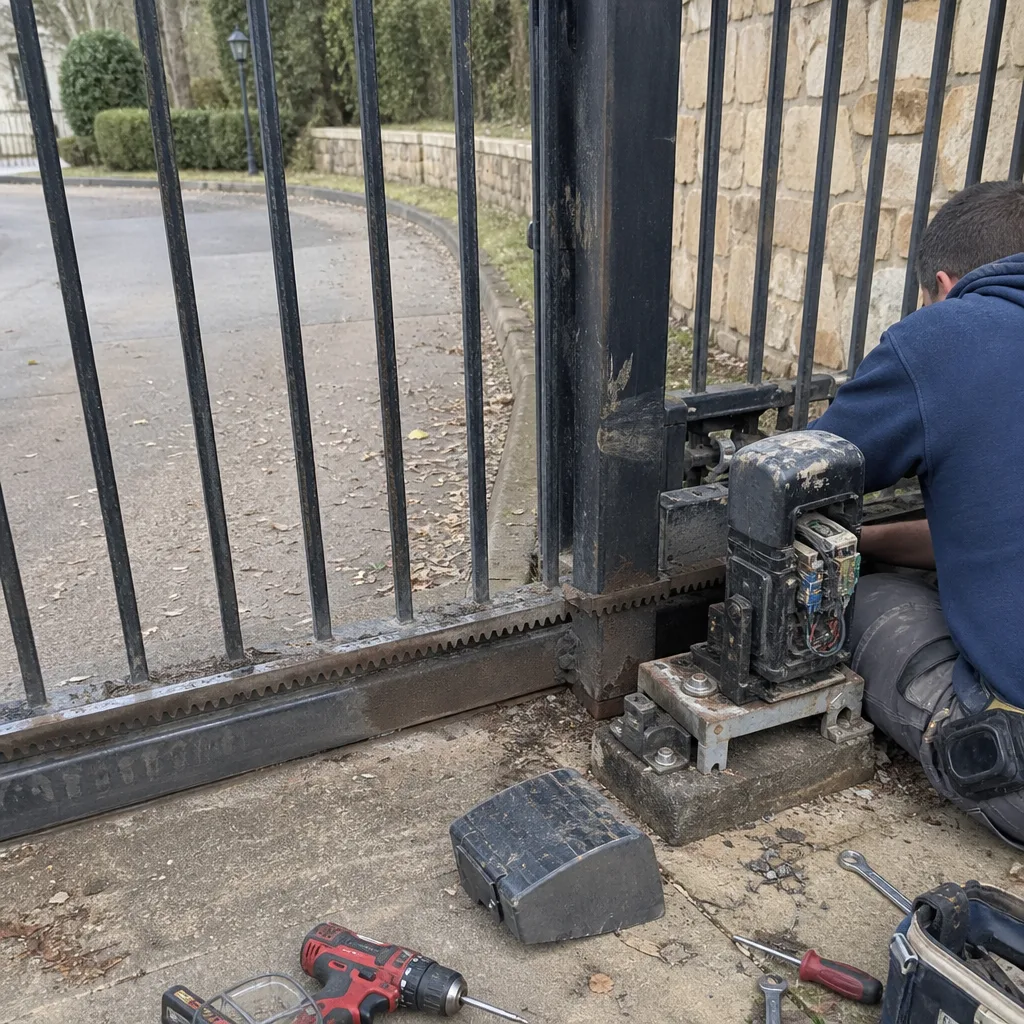 Before
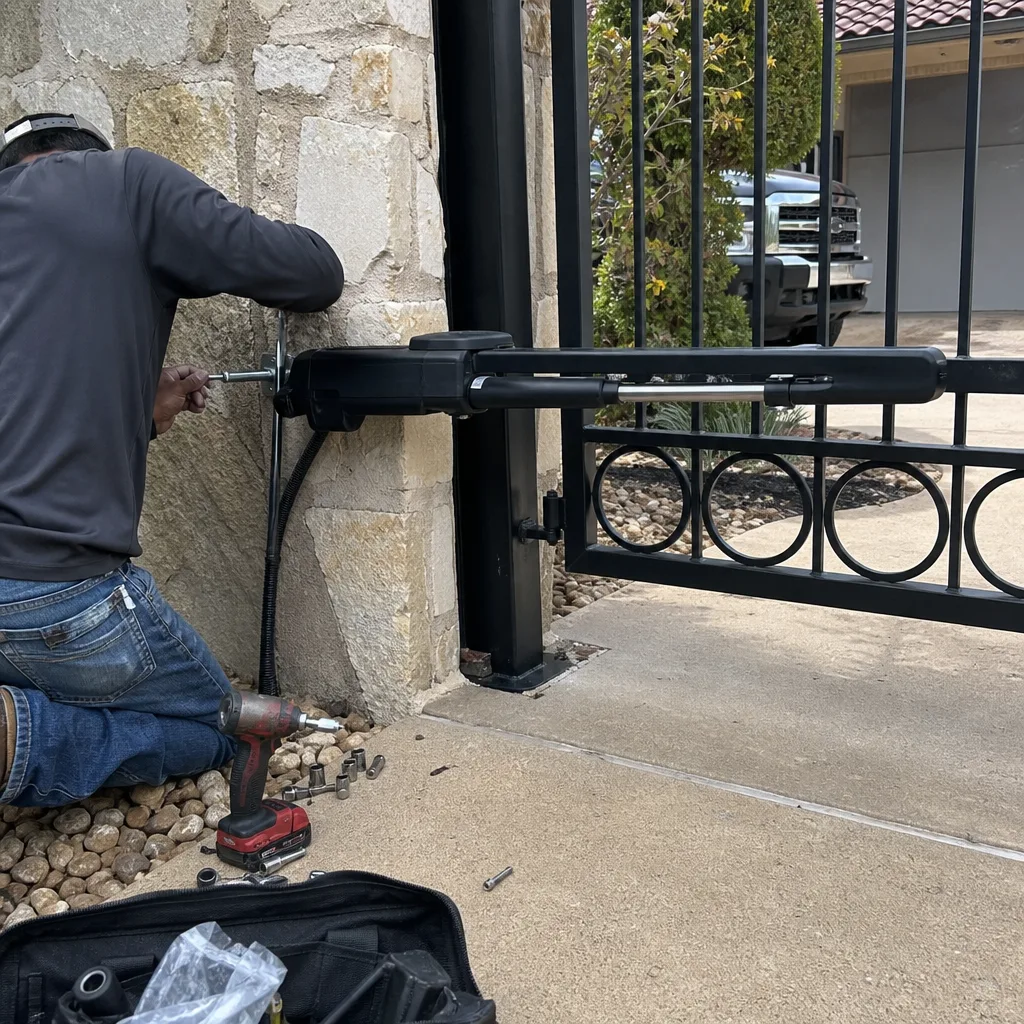 After
After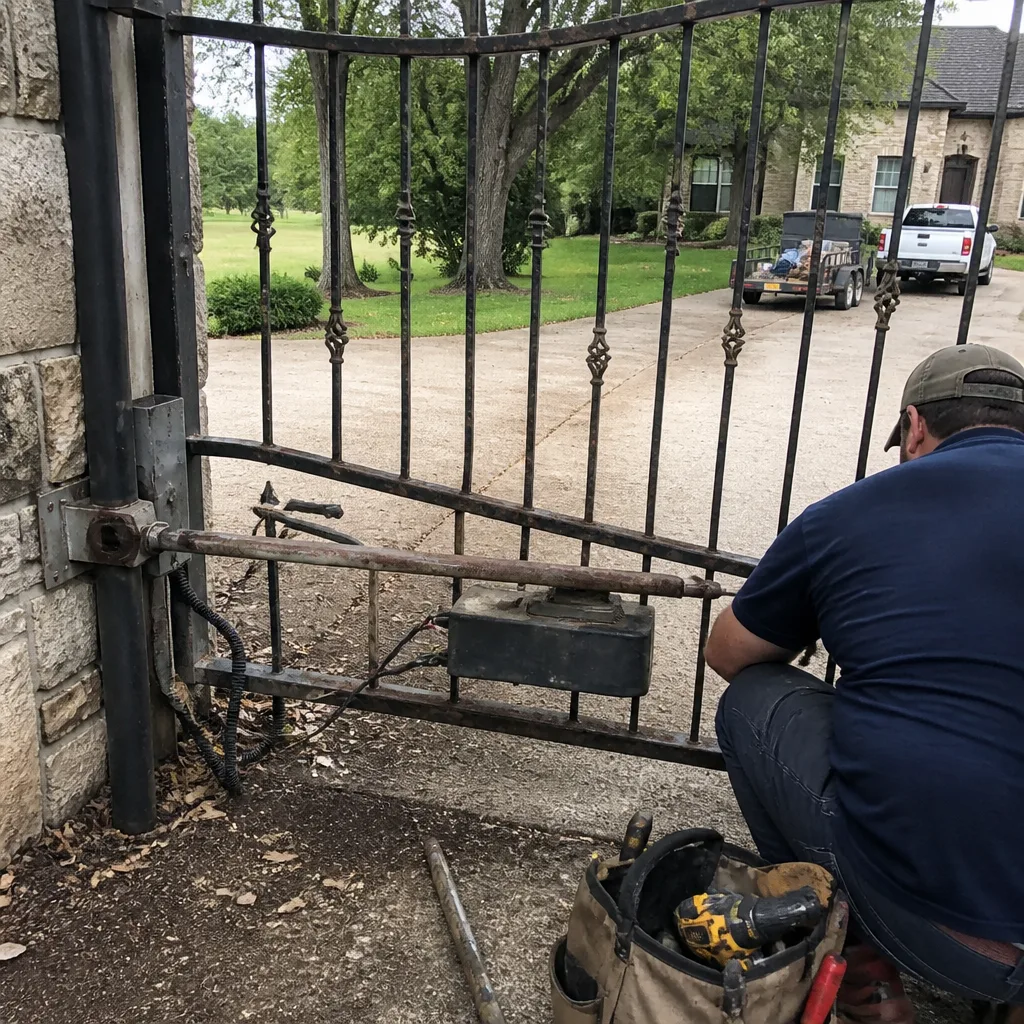 Before
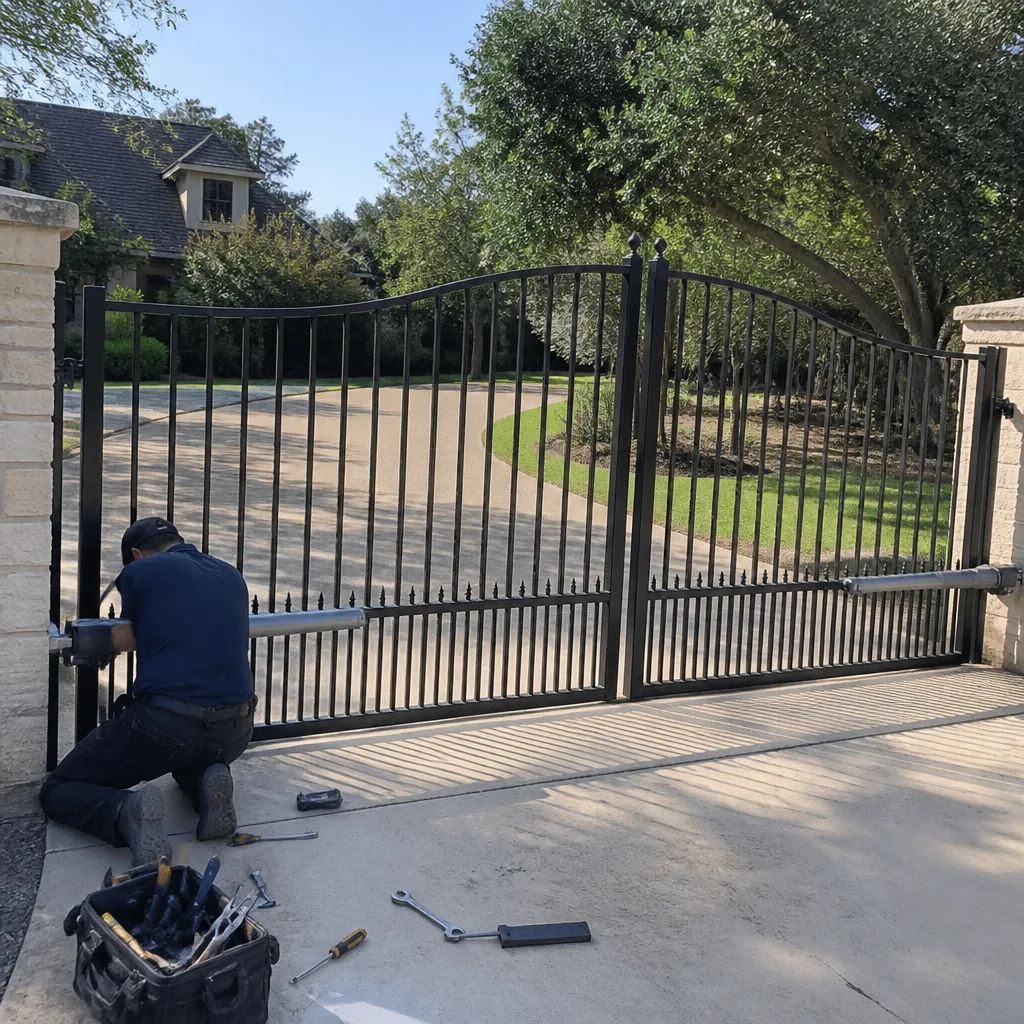 After
AfterDIY vs Professional Gate Repair: The Colleyville Homeowner’s Decision Guide
Here is a number that surprises most Colleyville homeowners: a gate that binds, scrapes, or stops mid-cycle is rarely one problem. It is usually three or four small failures that have learned to work together. The hinge has sagged, so the latch no longer lines up. The latch misalignment made the opener strain, so the limit switch drifted. The drifting limit switch turned a ten-second cycle into a forty-second grind, which finished off a capacitor that was already tired. None of these is hard to fix on its own. Diagnosing all of them, in the right order, on a 400-pound steel gate in July, is where the trouble starts. This guide walks through what a Colleyville homeowner can safely handle with basic tools, what tends to go wrong when you guess, and where the line sits between a Saturday project and a call to someone who does this every day.
Quick Answer
For most gate repairs in Colleyville, professional service is the better financial decision once the job involves anything beyond cleaning, lubrication, tightening visible bolts, or replacing batteries and remotes. What looks like a simple fix often has two or three underlying causes, and a misdiagnosed repair can damage the opener, the gate frame, or both. The DIY jobs that make sense are maintenance tasks and the simplest mechanical fixes; everything involving springs, welds, circuit boards, or a gate that has come off its track warrants a trained technician.
Table of Contents
- What Homeowners Can Safely Handle
- The Real Costs of DIY Gate Repair
- The Three Most Common Gate Problems in Colleyville
- When DIY Becomes Dangerous
- A Decision Framework: Four Questions to Ask
- What Professional Repair Actually Costs in Colleyville
- How to Choose Between DIY and Pro
- Common Mistakes to Avoid
- When to Call a Professional
- Frequently Asked Questions
- The Bottom Line
What Homeowners Can Safely Handle
We tell Colleyville homeowners this plainly: there are about five gate jobs that a reasonably handy person can do with a socket set, a can of lithium grease, and a half hour. The rest of it, in our experience, goes better with a truck in the driveway.
The safe list starts with lubrication. Gate hinges, rollers, and the opener’s drive chain or screw need grease two or three times a year in North Texas. Colleyville’s climate is hard on metal: dry heat through the summer, sudden freezes that put moisture inside moving parts, and clay soil that shifts under gate posts with every rain-dry cycle. A gate that squeals when it moves is telling you something, and that something is often just friction. A can of white lithium grease on the hinge pins and a silicone spray on the roller tracks fixes a surprising share of noise complaints.
Cleaning is the second safe job. The safety sensor eyes on either side of the gate opening collect dust, spider webs, and grass clippings faster than you would think. A soft cloth and a gentle wipe restore the beam. Third on the list is tightening. Gate hardware vibrates loose over time, particularly the bolts on the opener mounting bracket and the hinge plates. A snug-up with a socket wrench is fine.
Fourth is batteries and remotes. A dead remote is the single most common service call we get, and the fix takes ninety seconds. Change the battery in the transmitter. If that does not work, check the opener’s backup battery, which most modern units have. Finally, checking the auto-close setting is simple and worthwhile. If your gate stopped closing on its own after a power blink, the setting may have reset.
The line is this: if the job involves a wrench on a bolt that already exists, it is probably DIY territory. If it involves a welder, a spring under tension, a circuit board, or a gate that has come loose from its hinges, that is a different conversation, and we will get to it below.
The Real Costs of DIY Gate Repair
The math on DIY looks simple from the driveway: a replacement part online costs less than a service call. The truth, after years of seeing Colleyville gates that were “fixed” a month earlier, is more complicated. The real cost of a DIY repair is the cost of the wrong part plus the cost of the right part plus the cost of whatever the wrong part damaged before it was discovered.
Start with the parts themselves. Gate opener brands like Ghost Controls, DoorKing, and Elite sell through a network of authorized dealers for a reason. A homeowner buys a control board from an online marketplace, and it arrives without a serial number, without warranty registration, and sometimes without the correct firmware for the gate’s travel limits. Now the gate runs too far, slams into the stop, and bends the gate leaf. A $150 gamble becomes a $900 repair that needs a welder.
Then there is time. A gate repair that takes our technician forty-five minutes starts with four years of doing it daily. A homeowner researching the same job online, buying tools, watching videos, making two trips to the hardware store, and discovering mid-job that a bolt is seized has spent most of a Saturday. That is not waste; it is learning. But it is not free, and for a Colleyville homeowner who is 55 or older, as most of our customers are, a Saturday under a hot Texas sun has a real cost too.
And then there is the cost of failure. A gate opener wired incorrectly does not always just not work. Sometimes it works but reverses mid-cycle. Sometimes it closes on a sensor it should not. On a driveway where grandchildren play, the failed repair is not just an inconvenience. It is a liability.
The Three Most Common Gate Problems in Colleyville
In over forty years of gate work in the North Texas area, we have seen three problems more often than all others combined. Knowing what they are clarifies the DIY question, because two of the three are not what homeowners usually guess.
Gate sagging or dragging. In Colleyville, the soil is expansive clay. It swells when it rains and contracts when it dries, and it does this in cycles that move gate posts millimeters at a time over decades. The result is a gate leaf that no longer hangs square. The gate scrapes the driveway on the latch side, or the hinges bind. A homeowner can sometimes buy a year by tightening hinge bolts or adding a wheel, but the actual fix is resetting or replacing the post, or welding an adjustment to the hinge. That is not a DIY job, and any online tutorial that says it is has not seen a 400-pound Colleyville driveway gate that has been moving in clay for twenty years.
Opener runs but gate does not move. Sometimes this is the emergency release, which is designed to be pulled and easy to reset. More often, it is a stripped drive gear, a sheared pin, or a broken chain. The repair is mechanical and takes less than an hour with the right part in the truck. Without it, a homeowner is on the phone with a parts supplier who asks for a model number on a data plate that has not been legible since 2016.
Gate opens halfway and stops, or reverses before closing. This is almost always a limit switch or safety sensor problem. On Mighty Mule and Ghost Controls openers, the limit adjustment is accessible and sometimes fixable with a screwdriver and patience. On DoorKing and Elite units, the limit is set digitally, and the failure is often a sensor that is telling the board the gate has already reached the end of travel. The diagnostic requires a multimeter and the wiring diagram. Most homeowners stop here, and that is a reasonable place to stop.
When DIY Becomes Dangerous
There is a category of gate repair that is not a question of skill but of safety. A gate is a steel or iron object weighing between 200 and 800 pounds, held by hinges, driven by a motor, and controlled by electronics that can fail unpredictably. When it moves, it carries enough force to break bones. When it falls, it can kill.
Anything involving the gate springs falls in this category. Gate springs, unlike garage door springs, are often overlooked because they sit inside the hinge or along the gate frame. They are under constant tension. If a homeowner loosens the wrong bolt while one is loaded, the spring releases its energy in a fraction of a second, and whatever is in the way takes the hit. We do not give instructions for this work, and neither should anyone else. Call someone who does it with the right tools and knows where the stored energy is waiting.
Welding is the second dangerous job. It is not the heat that is the concern, though a torch near a wooden gate frame or dried Texas landscaping is risk enough. It is the quality of the weld. A gate that weighs hundreds of pounds and cycles open and closed dozens of times a day puts stress on every joint. A weld that looks fine but does not penetrate will fail, and when it fails, the gate falls. A certified welder with gate experience knows what a load-bearing weld on a moving structure requires. A homeowner with a borrowed stick welder does not.
Electrical work is the third category. A gate opener runs on 110 or 220 volts, and the transformer and control board sit in a metal box that gets rained on. A wiring mistake can start a fire, damage a $600 board, or energize the gate frame itself. If you are not certain how to check for voltage before touching a wire, do not touch the wire.
We say this not to scare anyone off doing the small jobs. We say it because a gate that fails is not like a dishwasher that stops working. It is a heavy moving object and a metal fence, and a bad repair on one can put people in danger.
A Decision Framework: Four Questions to Ask
A good way to decide whether a gate issue is DIY or professional is to answer four questions in order. If the first answer sends you to the “call” column, stop there. You have your answer.
- Is the gate still hanging correctly? If the gate is sagging, dragging, leaning, or has come off a hinge, the gate is unsafe. Stop and call a professional. A gate that is not hanging correctly puts every other component under stress, and any repair you make is a patch on a failing structure.
- Does the problem involve a spring, a weld, or house voltage? If yes, call. These three systems can injure you quickly and severely, and the repair requires training that no video can provide safely.
- Have you already tried the basics? Lubricated the hinges, cleaned the sensors, changed the remote battery, tightened visible bolts. If the gate still misbehaves, the problem is probably not basic. You have moved into diagnostic territory.
- Can you identify the exact part and the exact replacement? If you can read the model number, find a genuine replacement part from an authorized source, and the part does not require any of the work in question two, you may be able to handle it. If you are guessing at the part, do not. A wrong part in the right place is sometimes worse than no repair at all.
We have seen Colleyville homeowners solve gate problems themselves with this framework. We have also seen the same framework save a homeowner from opening a spring-loaded hinge with the wrong wrench. Both outcomes are wins.
What Professional Repair Actually Costs in Colleyville
Before you decide between DIY and pro, it helps to know what a professional repair actually costs in Colleyville. These are the ranges we see across the local market, not national averages. Prices shift with parts availability and the gate’s age, but this gives you a realistic band.
- Diagnostic visit: $59 to $129, often applied toward the repair if you proceed.
- Remote programming or replacement: $45 to $115.
- Sensor cleaning and alignment: $75 to $150.
- Hinge tightening with minor adjustment: $95 to $190.
- Limit switch adjustment: $110 to $210.
- Opener gear or chain replacement: $190 to $380 including parts.
- Control board replacement: $280 to $550 depending on brand and model.
- Gate re-hang with post reset: $350 to $900 depending on access and framing.
- Full opener replacement with installation: $900 to $2,400, with the spread driven by automation features, gate weight, and brand.
A few honest notes about these numbers. A cheap repair on a gate is not the same as a good one. If a quote comes in far below these ranges, ask what is included. A handyman who charges $60 and adjusts the limit switch but does not notice the hinge that caused the limit to drift has just sold you a $60 waste of money. The gate will fail again in a month. We honor standing offers at Ironworks Gate Co. that help Colleyville homeowners keep these costs in check: $50 off any repair over $250, a free second opinion on any written estimate, an $89 seasonal tune-up, and a permanent 5% discount for seniors and veterans.
Ironworks Gate Co. works on nine major opener brands, including LiftMaster, FAAC, BFT, Linear, Viking, Ghost Controls, DoorKing, Elite, and Mighty Mule, so the tech who arrives has already seen your opener’s quirks. Most jobs are completed in one visit. And every job carries a written 90-Day Done Right Promise. If it is not right, we come back and make it right. No paperwork, no argument.
How to Choose Between DIY and Pro
If the four questions above did not settle it, here is a practical way to think about the decision. DIY makes sense when the job is maintenance and the downside of a mistake is small. Professional makes sense when the job is a repair and the downside of a mistake is a bigger repair.
We tell Colleyville homeowners to think of it like tire pressure versus a timing belt. You check your own tire pressure. You do not replace your own timing belt unless you are a mechanic. A gate opener is closer to a timing belt than a tire. It is a machine with tolerances, and when those tolerances are off, the machine destroys itself slowly and sometimes suddenly.
There is also a question of final cost. A common story in our service area: a homeowner spends $80 on a generic control board, two weekends installing it, and then calls us because the gate opens but will not close. We find the board was not compatible with the safety-edge sensor, which then failed in a way that damaged the gate’s limit assembly. The final repair bill is $400 more than the original fix would have been. The homeowner did not save money; he paid tuition.
None of this means you should not do the maintenance. Do the maintenance. Grease the hinges. Clean the sensors. Change the batteries. Tighten the bolts. The homeowner who does these things gets more years out of every component, and when a real repair is needed, it is smaller and cheaper because the gate was not fighting itself for three years before anyone noticed.
If you are in Colleyville and want a second opinion before you decide, call us. A live person answers, 24 hours a day, 7 days a week. We will tell you whether the job sounds like something you can handle. If it is, we will say so. If it is not, we will tell you what it should cost and we will quote the price before any work begins.
Common Mistakes to Avoid
- Overtightening hinge bolts. A gate hinge needs to move. Crank a hinge bolt down until it cannot budge, and the gate binds, the opener strains, and the motor burns out early. Snug is enough.
- Using WD-40 where grease belongs. WD-40 is a water displacer and a light solvent, not a metal-on-metal lubricant. It works for a day and then washes out, leaving the hinge drier than before. Use white lithium grease on hinge pins, silicone spray on rollers.
- Replacing the opener to fix the gate. If the gate is sagging or the hinges are shot, a new opener will strain the same way the old one did. The opener is rarely the root cause when the gate leaf has been dragging for years. Fix the gate first.
- Buying a generic replacement part without checking compatibility. Gate opener brands are not interchangeable, even when the connector looks right. A Ghost Controls board does not talk to a DoorKing sensor without a translator, and the translator does not exist. Match the part to the unit.
- Ignoring the safety sensors after a DIY repair. When a gate is installed or adjusted without the photo-eye sensors connected and aligned, it will close on whatever is in the way. The sensors are not optional. They are the difference between a gate and a hazard.
- Working on a gate while it is under power. Disconnect the power and the backup battery before touching wiring. Every year, a gate owner gets a shock from a control board that “should have been off.” A multimeter is fifteen dollars. A hospital visit is not.
- Assuming the spring is “not that tight.” Gate springs store energy even when the gate is not moving. The load is always there. If you do not know how to release the tension safely, you do not touch the spring. We have seen the result of guessing, and it is not worth the savings.
When to Call a Professional
Call a professional when the gate is no longer hanging correctly, when it has come off a hinge or wheel, or when it makes a sound you have not heard before and cannot identify. Call when the opener trips a breaker, works intermittently, or does nothing at all after you have checked the battery and the power. Call when there is visible damage to a weld, a crack in the metal, or a leaning post. Call when a vehicle has hit the gate, even if the damage looks cosmetic, because the impact has traveled through the frame into the hinges and opener, and the next failure may be weeks away. Ironworks Gate Co. offers free estimates in Colleyville, and a live person answers the phone at (817) 242-5426 any hour of the day. If you are not sure whether your gate is safe, call. A free estimate is exactly that: free.
Frequently Asked Questions
Gate repair in Colleyville typically runs from $95 to $550 for most mechanical and electrical fixes, with full opener replacement from $900 to $2,400. The spread depends on the gate’s size, age, brand, and whether the frame or hinges need work in addition to the opener. Ironworks Gate Co. gives a written quote before any work starts, so the number on the estimate is the number you pay, and we offer $50 off any repair over $250. Call (817) 242-5426 for an exact quote.
You can handle remote batteries, sensor cleaning, and visible bolt tightening yourself, but most opener repairs require a multimeter, brand-specific knowledge, and the right parts. If you open the control box and see a wiring board, you have already gone farther than most successful DIY repairs go. For anything beyond the basics, call a pro who services your opener’s brand.
Sagging gates caused by expansive clay soil are the most common gate problem in Colleyville. The soil expands and contracts with rain and drought, shifting gate posts over time and causing the gate to scrape or bind. The fix is usually a re-hang or a welded hinge adjustment, not a DIY bolt-tightening job.
The short answer: most openers can be repaired if they are less than 15 years old and the control board is available. If the opener is older than 15 years, used parts are scarce, or the motor itself has failed, replacement is often the better financial call. Ironworks Gate Co. services nine major brands including Ghost Controls, DoorKing, Elite, and Mighty Mule, so we can identify whether a repair is worth the money on your specific unit. Call (817) 242-5426 and describe what the gate is doing; we will tell you what we think it is and what the likely repair looks like.
That depends on how you use the gate. A manual gate has fewer things that fail: no opener, no sensors, no control board, no remote. If you open the gate once a day and you do not mind getting out of the car, a manual gate will outlast its automated cousin and cost almost nothing to maintain. If you open the gate multiple times daily, in the rain, after dark, or you want access control for security, an automated gate earns its keep. The important thing is to match the gate to how you actually live, not to a sales pitch.
Yes. Ironworks Gate Co. gives free estimates in Colleyville and throughout our North Texas service area. A live person answers the phone 24 hours a day at (817) 242-5426, schedules the visit at your convenience, and gives you a written quote before any work begins. The price we quote is the price you pay.
The Bottom Line
DIY gate work has a place, and that place is maintenance. Grease the hinges, clean the sensors, change the batteries, tighten the bolts. If you do these things, your gate will last longer and cost less to repair when something real breaks. When something real breaks, the math changes. A sagging gate, a spring under tension, a control board that is misbehaving, a failed weld: these are not Saturday projects. They are jobs for a technician with the right tools and the right experience, and in Colleyville, the cost of a professional repair is often lower than the cost of a DIY attempt that goes sideways. Ironworks Gate Co. has served Colleyville since 1984, and we still answer the phone ourselves, every time. If your gate is misbehaving and you are not sure which side of the line you are on, call (817) 242-5426. We will tell you straight.
Written by Victor Salinas, Owner at Ironworks Gate Co., serving Colleyville since 2013.