
Last updated August 25, 2026
Free on-site gate assessment - hinges, posts, and your LiftMaster or Nice gate operator checked before anything is quoted
The assessment is free and the quote is the invoice.


 Before
 After
After Before
 After
After Before
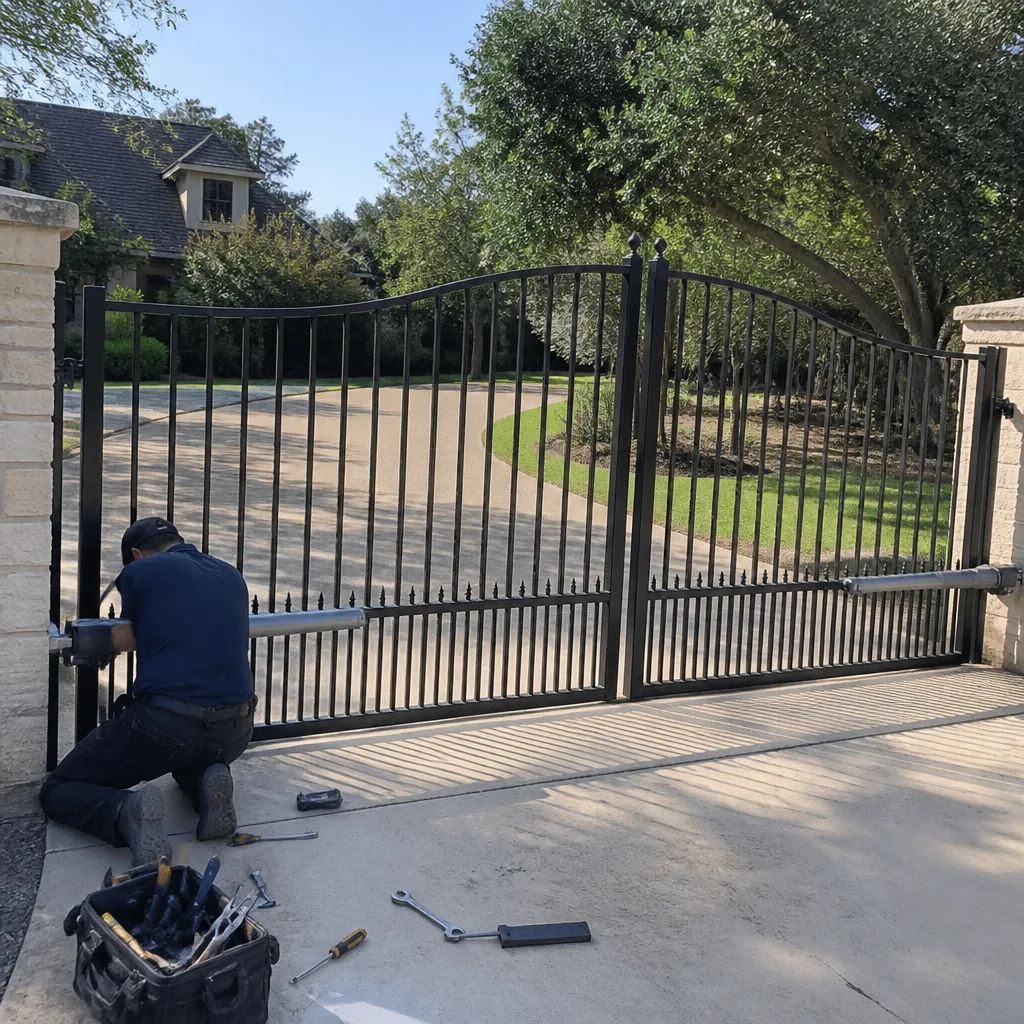 After
AfterSeasonal Gate Repair Care for Colleyville: Year-Round Homeowner’s Guide
Most Colleyville homeowners do not think about their driveway gate until the day it will not open, the day it will not close, or the day it starts sounding like a dying animal. That silence is not a sign of health. It is usually a sign that small problems are quietly compounding. A gate is the largest moving object on most properties, and it sits outside in Texas weather for every one of the 8,760 hours in a year. This guide walks through exactly what that weather does to your gate, season by season, what you can handle as a homeowner, and what should be left to a professional before a $40 bearing failure becomes a $2,000 motor replacement in Colleyville.
Quick Answer
Seasonal gate care in Colleyville comes down to six things: inspect hinges and welds for rust each spring, adjust opener force settings when temperatures swing, clear leaf litter and debris from the track in fall, lubricate moving parts before first freeze, check safety sensors after any severe storm, and tighten every bolt on an annual schedule. Most gate failures here are slow motion, caused by weather and neglect working together, and nearly all are preventable with an hour of attention twice a year. A professional tune-up runs $89 and catches problems while they are still cheap to fix.
Table of Contents
- Why Colleyville Weather Is Hard on Gates
- Spring Gate Care: Recovering from Winter and Getting Ready for Storm Season
- Summer Gate Care: Heat, Dry Soil, and the Strain of Constant Use
- Fall Gate Care: The Most Important Maintenance Window of the Year
- Winter Gate Care: Cold Snaps, Contraction, and What Freezing Does to Metal and Motors
- The Seasonal Tune-Up Checklist: What a Real Inspection Covers
- Common Mistakes to Avoid
- When to Call a Professional
- Frequently Asked Questions
- The Bottom Line
Why Colleyville Weather Is Hard on Gates
Colleyville sits in a weather corridor that punishes outdoor metal and electronics. The summer months bring 100-degree days that bake powder coating, expand steel, and push opener motors to thermal shutdown. Spring and fall bring sudden temperature swings, sometimes 40 degrees in 36 hours, which forces metal components through constant expansion and contraction cycles. The winters are generally mild, but the few hard freezes we do get arrive with a particular cruelty for anything mechanical: metal contracts, grease thickens, batteries weaken, and plastic parts become brittle.
We have worked on gates in Colleyville since 2013, and the pattern across every neighborhood, from Montclair Parc to Remington Park to the larger estates off Pleasant Run Road, is the same. The gates that fail are not the gates that get used hard. They are the gates that get ignored. A gate that swings or slides 2,000 times a month will often outlast one that opens 60 times a month, because regular use keeps moving parts moving, keeps grease distributed, and keeps small problems from seizing into big ones. The gate that sits still through a wet spring and a hot summer is the one that surprises its owner with a $1,600 motor and gearbox replacement in October.
The soil here matters too. Colleyville sits on a mix of clay and loam that expands and contracts with moisture. That movement shifts gate posts. A post that is off by less than half an inch can change the geometry of the entire gate, putting uneven load on hinges, causing the opener to work harder, and eventually burning out a board or stripping a gear. Homeowners in older neighborhoods with large trees, particularly along Cheek-Sparger Road and the Glade Road corridor, see more of this because tree roots shift soil and the trees themselves drop debris that fouls track systems.
Spring Gate Care: Recovering from Winter and Getting Ready for Storm Season
Spring in Colleyville is the season of inspection. March through May is the right window to look over every inch of the gate and ask one question per component: is this as tight, clean, and lubricated as it should be. Spring is also the beginning of storm season, and North Texas storms arrive fast, with wind gusts that can turn a 400-pound gate into a sail. A gate that is properly adjusted survives a 60-mile-per-hour gust. A gate with loose hardware does not.
Spring Inspection Steps
- Check every weld joint and hinge point for rust. Surface rust is manageable. Deep rust is a structural problem. Pay particular attention to the bottom hinge, which collects water and road splash.
- Tighten every bolt and screw you can see. The thermal cycling of a Texas winter loosens hardware even when the gate was installed correctly. A socket set and 20 minutes catches most of it.
- Clean the track if you have a slide gate. Winter debris including dried leaves, mud, and gravel works its way into the track and acts like sandpaper on the rollers. A clean track means less motor strain.
- Test the safety sensors. Put an object in the gate path and confirm the gate reverses. After a winter of rain, spider webs and dirt films on sensor lenses are common and cause false stops or failures to stop.
- Check the battery backup if your opener has one. Spring thunderstorms knock out power. A dead backup battery means your gate does not open during an outage, which is exactly when you need it to.
We see a recurring spring issue in Colleyville that most homeowners would never think to check: wasp and dirt dauber nests inside opener housings and control boxes. These nests bridge electrical contacts, trap moisture, and have caused more than a few fried circuit boards. If you open your control box and find a mud nest, do not scrape it out by hand. Cut power first, then clean it out and check for corrosion on the terminals beneath. This is a simple fix that prevents a real problem.
Summer Gate Care: Heat, Dry Soil, and the Strain of Constant Use
Summer is when Colleyville gates get used the most, and it is also when they run the hottest. An opener motor mounted in a black metal housing in direct July sun can reach internal temperatures above 160 degrees. That heat shortens the life of capacitors, degrades motor windings over time, and causes thermal overload circuits to trip. When a gate stops working on a 104-degree afternoon and then works fine the next morning, that is the thermal overload doing its job, and it is a warning sign that the opener is working too hard.
The heat also affects the ground under the gate. Extended dry periods shrink the clay soil Colleyville is built on, which can cause gate posts to shift. A post that sinks or tilts changes the alignment of the entire gate, and the opener compensates by drawing more current. More current means more heat. More heat means a shorter motor life. If your gate is rubbing a post or the ground during July and August, that is not just an annoyance. It is a slow mechanical failure.
Summer Gate Care Tasks
- Inspect opener housing for direct sun exposure and consider a shade structure or housing if the unit sits in afternoon sun.
- Listen for a change in motor pitch during operation. A motor that sounds strained or “boggy” is working against resistance.
- Check the gate path clearances at both ends of travel in the late afternoon, when thermal expansion is at its peak.
- Lubricate hinges, rollers, and chain drives lightly with the correct lubricant. Heat thins grease, and moving parts working without proper film build heat faster.
- If you have an intercom or keypad on a post at street level, check the housing seal. UV exposure turns plastic brittle, and the summer monsoons get water inside.
One note on lubrication that will save you from making a mess: the correct product for residential gate hinges in the Colleyville climate is a white lithium spray grease or a synthetic multi-purpose grease, not WD-40 and not used motor oil. WD-40 is a solvent that strips the existing lubrication. Used motor oil attracts dust, and in North Texas summers, that dust bakes into a grinding paste. The wrong lubricant is worse than none at all.
Fall Gate Care: The Most Important Maintenance Window of the Year
If you only do one maintenance session on your gate each year, do it in fall, specifically October and November when the heat has broken but before the first hard freeze. Fall is the season of catching up: everything the summer heat and spring storms did to your gate can be found and fixed in one focused session. It is also the season of leaves, and leaves are the enemy of slide gates in particular. Colleyville has a mature tree canopy, which is lovely on a walk through the neighborhood and brutal on gate mechanics. Leaf litter packs into tracks, rots into a damp acidic mulch, and accelerates corrosion on the parts it touches.
Fall is also when we recommend an $89 Seasonal Tune-Up, because the tune-up is the most efficient way to get a trained set of eyes on every moving and electrical component at once. But for the homeowner who wants to do it themselves, here is the fall procedure in order.
- Remove all leaves and organic debris from the track, the gate frame channels, and around the base of the posts. Use a leaf blower first, then a stiff brush. If you have a slide gate, clear the full travel length.
- Inspect the gate frame for any rust spotting and treat it. Sand lightly, apply a rust-inhibiting primer, and touch up with a matching paint or powder-coat repair compound. Small spots ignored in October become rust-through by March.
- Grease all hinge points, rollers, and the drive chain or belt. Work the gate through a full cycle to distribute the grease.
- Check the opener force settings. Summer heat and heavy use can alter the amount of force the opener needs to move the gate. If the gate is harder to move than it was in spring, find out why before adjusting force upward. Adjusting force up masks the problem instead of fixing it.
- Test the auto-reverse and all photo-eye sensors. This is a safety system, not a convenience. It requires a clear line of sight and clean lenses.
- Check every lock, latch, and keypad. Battery keypads often die quietly in late fall. Replace the battery before the first freeze, because accessing the keypad in freezing weather is miserable.
Do not skip fall lubrication because the gate “still works fine.” The point of fall lubrication is not to fix a problem. It is to preserve function through the winter contractions and spring storms ahead. A properly lubricated gate is quieter, uses less motor current, and wears its parts at a much slower rate. This is the highest-return maintenance hour on the calendar.
Winter Gate Care: Cold Snaps, Contraction, and What Freezing Does to Metal and Motors
Winter in Colleyville is comparatively short, but the cold snaps we get are enough to cause real gate failures. The mechanism is simple physics. Steel and aluminum contract as temperatures drop. A gate that was adjusted to perfect alignment on an 85-degree October day will be slightly out of alignment on a 28-degree February morning. Most of the time, the opener compensates. Sometimes it cannot. Hinges that were already worn bind in the cold. Grease thickens at low temperatures and adds resistance. Battery backup systems that tested fine in November have reduced capacity in February, because all lead-acid and lithium batteries lose capacity in cold weather.
What to Watch For in Winter
- Slower gate travel speed. Cold grease and contracting metal create drag. A gate that moves noticeably slower in January than in September is telling you that friction has increased.
- Opener hums but gate does not move. This can be a cold-seized motor, a stripped gear, or simply a gate frozen to the ground after an ice event. Do not repeatedly force the opener if the gate is visibly frozen. Clear the ice first, then operate.
- Keypad or intercom responds intermittently. Cold weakens batteries and can cause display failures on LCD keypads. If you have a gate that opens from the inside button but not from the keypad, test the keypad battery.
- Gate drifts out of position after closing. Cold-soaked circuit boards can hold a charge differently, and some openers’ limit settings drift slightly in temperature extremes. If it happens once or twice on the coldest days, note it. If it happens every day, get it looked at.
- Confirm battery backup holds a full charge before the first freeze.
- Replace keypad batteries in December, whether or not the low-battery warning has shown.
- Verify the gate seals well against the closed position, keeping cold wind and driven rain out of the opener housing.
- Keep a bag of de-icing compound near the gate for January, but use calcium chloride or sand rather than rock salt, which accelerates corrosion on steel components.
- Plan for ice events: know where your manual release is and how to use it so a power outage during an ice storm does not trap you on one side of the gate.
- Full mechanical inspection: every hinge, weld, bolt, roller, and bracket inspected and tightened to specification.
- Opener diagnostics: force settings checked, limit switches verified, circuit board inspected for corrosion or heat damage, and motor current draw measured against manufacturer spec.
- Safety system verification: photo-eye alignment and function, auto-reverse sensitivity, and obstruction detection tested.
- Electrical connection check: all wires, terminals, and splices inspected for looseness, corrosion, or heat discoloration.
- Lubrication service: all moving parts lubricated with the correct products for the specific hardware, not a generic spray-and-pray.
- Brand-specific calibration: because we are trained and equipped on nine gate-automation brands including Ghost Controls, Linear, and Mighty Mule, the adjustments we make match the manufacturer’s actual specifications for your specific opener.
- Written condition report: we tell you exactly what we found, what we recommend, and what it will cost before any work happens. Future repairs are quoted upfront, with no surprises on the bill.
- Using WD-40 on hinges and rollers. It is a solvent, not a lubricant. It strips the protective film that is already there and leaves metal surfaces more vulnerable to corrosion than before. Use a lithium or synthetic grease.
- Waiting until the gate fails to call anyone. The overwhelming majority of gate repairs we perform in Colleyville are the result of a $30 part that failed slowly and damaged a $600 part on the way down. Early intervention is the cheapest repair there is.
- Painting over rust without addressing it. Paint seals in active rust. The rust continues oxidizing underneath, and by the time it shows through again, the metal is often structurally compromised. Removal, primer, then paint is the correct order.
- Adjusting force settings to “fix” a binding gate. Increasing opener force to overcome mechanical resistance is a temporary patch that accelerates wear on every component from the motor to the hinges. Find and fix the binding instead.
- Letting landscape growth crowd the gate path. Hedges, ground cover, and low branches interfere with photo-eye sensors, block track clearance, and hold moisture against metal components. Keep a clear, open path on both sides.
- Ignoring a gate that runs on a generator or solar setup. Power quality matters to circuit boards. If your gate is on off-grid power, fluctuating voltage can damage control electronics over time. Surge protection is worth the small cost.
- Deferring maintenance because the gate is “new.” New gates need maintenance too, and the first year is actually the most important because hardware settles, bolts loosen, and factory adjustments drift. A new gate should be inspected at month six and again at month twelve.
One reality of North Texas winter: ice storms. When freezing rain coats a gate, the immediate instinct is to try to open it and see if it still works. That is exactly the wrong instinct. A gate frozen to its own track or frozen shut against a post can strip gears or burn out a motor in seconds when the opener fights the ice. The correct winter protocol after an ice event is to inspect the gate path visually, remove ice from the track and around the bottom of the gate, and only then attempt to operate it. If you see ice bonded into the gear rack or chain, wait for the thaw or melt it carefully. A hair dryer or warm water works. A hammer and chisel does not.
Winter Preparation Checklist
The Seasonal Tune-Up Checklist: What a Real Inspection Covers
We have been repairing gates in Colleyville long enough to know that most homeowners are capable of handling the basic maintenance described above. But there is a second layer of inspection that requires trained eyes and specialized tools, and that is the layer where small problems are caught before they become $1,500 problems. Our Ironworks Gate Co. home service standards include a written 90-Day Done Right Promise on every job, and our $89 Seasonal Tune-Up includes the complete inspection and adjustment list below.
What a Professional Tune-Up Includes
One thing a tune-up is not: a sales call in disguise. We report what we find, quote what it costs, and if nothing needs repair, we say that plainly. That is the Keystone Standard, and it applies to the 400th job exactly as it applied to the first in 1984.
Common Mistakes to Avoid
When to Call a Professional
Some gate issues are straightforward homeowner territory: battery replacement, track cleaning, visual inspections, light lubrication. Others are not, and pushing through them with good intentions gets expensive. Call a professional when the gate has come off a post or hinge, when the opener motor hums without moving the gate, when you smell burning from the control box, when visible welds are cracked or broken, when the gate moves unevenly or shudders through its travel, or when any electrical component sparks, smokes, or trips a breaker. Gate openers contain high-tension springs and high-current electrical components, and both carry genuine injury risk. A spring under torsion can release with enough force to break a hand. Circuit boards wired incorrectly can short and arc. This is not work we encourage homeowners to attempt beyond the maintenance level described above. Ironworks Gate Co. offers free estimates in Colleyville, call (817) 242-5426 and a live person answers, day or night.
Frequently Asked Questions
We recommend a full professional inspection and tune-up twice a year, once in March or April and once in October or November, with homeowner maintenance checks quarterly. The spring service prepares the gate for storm season, and the fall service prepares it for winter contraction. Gates on larger estates or gates that cycle more than 30 times per day may need service three or four times a year. Call (817) 242-5426 to schedule an $89 Seasonal Tune-Up, the written report comes with it.
Colleyville gate repair pricing varies by the component, but as a benchmark, expect $150 to $300 for hinge or roller replacement, $200 to $450 for board-level opener repairs, $500 to $1,200 for a complete motor replacement depending on brand and horsepower, and $200 to $800 for welding repairs depending on extent. Our $50 Off Any Repair Over $250 offer applies to most jobs, and every quote is settled before work begins, not after. Senior and veteran customers receive a permanent 5% discount.
The most common failure we see in Colleyville is a dead opener motor that was overworked because the gate itself was binding, usually due to lost post alignment from soil movement. The second most common is a blown control board caused by a power surge, which is why we recommend surge protection on every opener that does not have it. Both failures are among the more expensive repairs, and both are caught by regular tune-ups before they become dead-on-arrival failures.
In most cases for repair work, yes. We maintain stocked vehicles for common repair parts across all the brands we service, including DoorKing, Elite, and Ghost Controls, and a live person answers the phone 24 hours a day, 7 days a week. Emergency gate failures are dispatched as quickly as possible, and most standard repairs are completed in a single visit with upfront pricing agreed before work starts.
A full installation includes site evaluation, post setting, gate fabrication or assembly, opener installation, electrical power run, safety sensor placement, access control integration if requested, and a final calibration and adjustment pass. We do not offer same-day installation because a proper installation is measured, ordered, and scheduled, but we do offer a free measure and a written price for every installation we quote. Every installation carries the 90-Day Done Right Promise in writing.
Yes. We run the power from your panel to the gate opener, install the required photo-eye safety sensors, and set up safety edges or obstruction detection systems as required for your gate type and automation. Low-voltage control wiring, keypad wiring, and intercom lines are included in installation scope. The work is quoted as a complete line-item price before we begin, and the finished installation is backed by the written 90-Day Done Right Promise.
The Bottom Line
Your gate is a mechanical system built from metal, electronics, and moving parts, and it lives outside in Colleyville’s full weather cycle: summer heat, spring storms, fall leaf litter, and winter ice. It needs seasonal attention, and the cost of that attention is trivial compared to the cost of the failures it prevents. Inspect in spring, maintain through summer, deep-service in fall, and prepare for ice in winter. If the $89 Seasonal Tune-Up is the easiest hour of maintenance you can buy in this city, it is also among the highest-return. Catch the small stuff early, and a gate installed in 1988 will still close like the day it was hung. Call (817) 242-5426 any hour of any day, and talk to a live person who knows this trade and stands behind it.
Written by Victor Salinas, Owner at Ironworks Gate Co., serving Colleyville since 2013.